
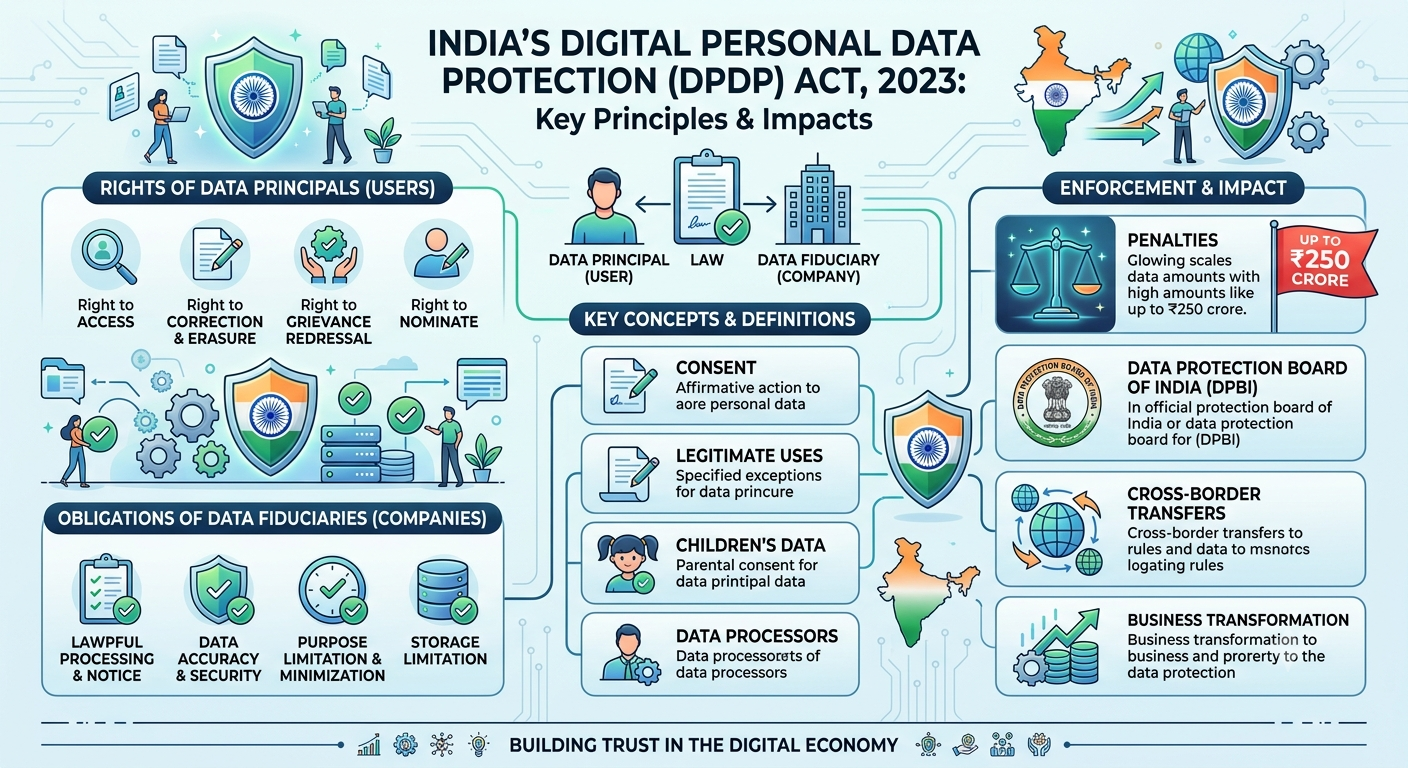
Transforming Data Governance: How India’s DPDP Act Changes Everything
In today’s digital-first economy, data has become the most valuable currency. Every time you order food from an app, apply for an instant loan, or book a doctor’s appointment online, you leave behind a trail of sensitive personal information.
For years, organizations operated in a landscape where data collection was largely unchecked—collecting as much user data as possible, storing it indefinitely, and occasionally monetizing it without explicit user awareness.
That era is officially over.
With the enactment of India’s Digital Personal Data Protection (DPDP) Act, the country joins global privacy leaders by establishing a legal framework that puts individuals back in control of their digital footprint.
Whether you are a founder, a product manager, a developer, or a consumer, understanding the DPDP Act is no longer optional—it is essential. In this deep dive, we break down what the law means, how data management is transforming overnight, and what it looks like in real-world scenarios.
1. The Core Pillars: What Is the DPDP Act?
The DPDP Act is designed to protect digital personal data while allowing organizations to process data for lawful, legitimate purposes. It introduces key terminology that defines the relationships between users, companies, and regulators:
- Data Principal: You, the individual. The citizen whose personal data is being collected or processed.
- Data Fiduciary: The enterprise, startup, or government body that decides why and how your data is processed.
- Data Processor: A third-party vendor or cloud platform processing data on behalf of a Data Fiduciary.
- Data Protection Board of India (DPBI): The official regulatory body established to enforce compliance and adjudicate breaches.
       +--------------------------------------------------------+
       |                     DATA PRINCIPAL                     |
       |             (The Individual / Citizen)                 |
       +---------------------------+----------------------------+
                                   |
                         Grants Explicit Consent
                                   |
                                   v
       +--------------------------------------------------------+
       |                     DATA FIDUCIARY                     |
       |             (E-commerce, Fintech, App)                 |
       +---------------------------+----------------------------+
                                   |
                        Outsources Processing
                                   |
                                   v
       +--------------------------------------------------------+
       |                     DATA PROCESSOR                     |
       |            (Cloud Host, Analytics Vendor)              |
       +--------------------------------------------------------+
The 4 Non-Negotiable Privacy Principles
- Lawful & Transparent Processing: You can only collect data for explicit, legitimate reasons with clear user consent.
- Purpose Limitation: You can only use data for the exact purpose stated when collecting it.
- Data Minimization: You must collect only the data strictly necessary to complete the task.
- Storage Limitation: Once the purpose is fulfilled (or consent is revoked), the data must be deleted.
2. Legacy vs. Post-DPDP Data Management: The Big Shift
How does daily business execution actually change? Let’s compare how enterprises managed data before the DPDP Act versus how they must operate today.
| Dimension | Legacy Data Management (Pre-DPDP) | Post-DPDP Implementation |
| Consent Model | Bundled terms, pre-checked boxes, hidden opt-outs, and dark patterns. | Unbundled, itemized consent in clear language. Must support English + 22 regional Indian languages. |
| Data Collection | “Collect everything now, figure out use cases later.” | Strict Data Minimization. If an app doesn’t need your contacts to deliver a order, asking for it is illegal. |
| Storage & Retention | Stored indefinitely in data lakes, test environments, and legacy backups. | Automated data lifecycle management. Data must be purged as soon as purpose ends or consent is withdrawn. |
| Data Breaches | Often hidden internally or delayed in disclosure to preserve public reputation. | Mandatory, non-negotiable reporting of every breach to both the DPBI and affected users without delay. |
| Child Data Protection | Basic age-gate checkboxes; behavioral tracking and targeted ads allowed for minors. | Verifiable parental consent required for children under 18. Zero tracking, profiling, or targeted ads permitted. |
| Cross-Border Transfer | Strict localization debates and complex legal contracts. | Blacklisting Model: Data can flow globally unless transferred to a country specifically restricted by the Government. |
3. Real-Time Industry Scenarios: Before vs. After
To understand how this plays out in real life, let’s look at three common user journeys across major industries.
Scenario A: E-Commerce & Retail Onboarding
Pre-DPDP:
Rahul downloads a new online shopping app. During sign-up, he clicks a single “Accept All” button covering a 20-page document. Unknowingly, he gives the app access to his contact list, precise GPS location, and camera roll. Three days later, Rahul receives unsolicited promotional calls from third-party insurance partners because the app sold its user database.
Post-DPDP:
The shopping app presents Rahul with an itemized notice. He chooses to share his delivery address and phone number for order updates, but toggles OFF contact list sharing and marketing partner access. Selling or sharing his contact details with third-party telemarketers without explicit opt-in is now a major legal violation subject to severe fines.
Scenario B: Fintech & Instant Micro-Loans
Pre-DPDP:
Priya applies for an instant micro-loan via a digital lending app. To evaluate her credit, the app requires access to her complete SMS history, social media activity, and full photo gallery. Even if Priya’s loan application is rejected, the app keeps her financial data stored permanently on its cloud servers.
Post-DPDP:
The lending platform is constrained by purpose limitation. Scraping SMS logs or non-financial photo apps is prohibited. The app can only request financial records needed to evaluate creditworthiness. If Priya’s application is rejected, or if she deletes her account, the fintech company must permanently purge all her personal data from its primary databases and third-party vendors.
Scenario C: Healthtech & Digital Teleconsultation
Pre-DPDP:
An online healthcare platform stores medical diagnostic reports and consultation notes in unencrypted cloud buckets. The platform shares anonymized medical records with an external AI startup to train diagnostic tools without informing the patients.
Post-DPDP:
Health data processing requires explicit consent and enterprise-grade encryption. The hospital cannot share diagnostic records with third-party AI developers without asking patients first via an unbundled, separate consent prompt. Furthermore, patients can log into a privacy dashboard at any time to click “Revoke Access”, obligating the hospital to delete non-essential health logs.
4. The High Cost of Non-Compliance
Under the DPDP Act, non-compliance is no longer a minor slap on the wrist. Fines are calculated per instance based on severity, deliberate nature, and system failure.
+-----------------------------------------------------------------------+
|                       DPDP PENALTY STRUCTURE                          |
+-----------------------------------------------------------------------+
| Up to ₹250 Crore ($30M+) | Failure to implement reasonable security    |
|                          | safeguards to prevent data breaches.        |
+--------------------------+--------------------------------------------+
| Up to ₹200 Crore ($24M+) | Failure to notify the DPBI & users about    |
|                          | a personal data breach.                    |
+--------------------------+--------------------------------------------+
| Up to ₹200 Crore ($24M+) | Violating special obligations regarding    |
|                          | children's data safety.                    |
+--------------------------+--------------------------------------------+
| Up to ₹150 Crore ($18M+) | Failure of Significant Data Fiduciaries to |
|                          | perform statutory audits/DPIA.             |
+-----------------------------------------------------------------------+
⚠️ Key Takeaway for Leadership: Fines under DPDP are not linked to corporate turnover, meaning even mid-sized companies and startups face enterprise-level financial penalties for negligence.
5. Technical Blueprint: How Companies Must Adapt
Achieving compliance requires a complete overhaul of how technical architectures handle data flows. Simply updating your website’s Privacy Policy page is not enough.
  [User / Principal]
          |
          v
+------------------+
| Consent Engine   | ---> Multilingual Notices & Granular Opt-Ins
+------------------+
          |
          v
+------------------+
| Data Pipeline    | ---> Minimization & Encryption Enforcers
+------------------+
          |
          v
+------------------+
| Lifecycle Manager| ---> Auto-Purging on Revocation / Expiry
+------------------+
The 5-Step Operational Roadmap for Businesses
- Comprehensive Data Mapping: Map every piece of personal data entering your ecosystem. Know exactly where it sits—across production databases, cloud buckets, SaaS tools, and log files.
- Implement Consent Managers: Integrate with consent management infrastructure so users can review, update, or revoke consent through a simple dashboard.
- Automate Data Erasure Scripts: Create automated cron jobs and database triggers that permanently purge user data once retention periods expire or when a deletion request is filed.
- Audit Third-Party Vendors: Ensure every Data Processor (hosting providers, analytics tools, marketing software) operates under legal contracts that enforce strict compliance standards.
- Appoint Key Roles: Entities classified as Significant Data Fiduciaries (SDFs) must appoint a resident Data Protection Officer (DPO) and conduct periodic Data Protection Impact Assessments (DPIA).
Conclusion: Privacy as a Competitive Advantage
The Digital Personal Data Protection Act represents a monumental shift in how digital businesses operate in India. While the transition requires technical investment and operational discipline, companies that move quickly will gain a distinct edge.
In a digital economy built on customer trust, treating user privacy as a fundamental right rather than a compliance burden is the ultimate competitive differentiator.
💬 What are your thoughts?
Has your organization started preparing for the DPDP Act? What challenges are you facing in managing consent and data deletion? Let’s discuss in the comments below!
Edit directly or with Gemini
Click anywhere to type and edit directly, or select text to prompt Gemini for changes.Transforming Data Governance